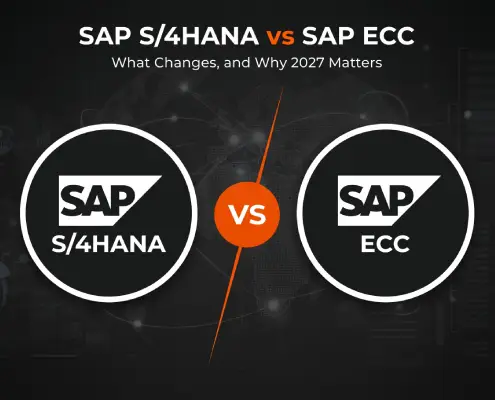
SAP S/4HANA vs SAP ECC: What Changes, and Why 2027 Matters
What changes, what the 2027 and 2030 dates mean, and how to plan your move.

What changes, what the 2027 and 2030 dates mean, and how to plan your move.
SAP ECC and SAP S/4HANA are two generations of SAP’s ERP. ECC is the long-running platform that still runs much of the enterprise world; S/4HANA is the current suite where SAP is putting all of its new investment. The difference matters now because the clock is running: ECC mainstream maintenance ends on 31 December 2027, with extended maintenance to 2030, and SAP’s newest cloud and AI capabilities arrive in S/4HANA first
This guide explains what actually changes between the two, from the database up, and what the 2027 deadline means for how you plan a move.
SAP ERP Central Component (ECC) is SAP’s previous-generation ERP suite, the backbone of finance, supply chain, procurement and more for thousands of organisations. It can run on various databases, uses the traditional SAP GUI, and carries a data model refined over two decades, often heavily customised. ECC is stable and deeply embedded, but it is end-of-life.
Scope it, resource it, secure a partner.
Enhancement Packs 6 to 8. Mainstream maintenance is not extended.
At a premium, security and compliance patches only.
SAP has confirmed that mainstream maintenance for ECC 6 (Enhancement Packs 6 to 8) ends on 31 December 2027, with extended maintenance available to 2030 at 2 percentage points above the standard maintenance fee, covering security and compliance patches rather than new capability.
SAP S/4HANA is SAP’s current ERP suite, built specifically for the in-memory HANA database. It replaces ECC with a simplified data model (fewer tables, real-time processing), the role-based SAP Fiori interface, and deployment options spanning on-premise, private cloud and public cloud.
The gap between ECC and S/4HANA widens with every release rather than staying fixed.
Crucially, S/4HANA is where SAP builds its newest capabilities first, including Business AI such as Joule and the Autonomous Suite agents.
| Criteria | SAP ECC | SAP S/4HANA |
|---|---|---|
| Status | Mainstream maintenance ends 31 Dec 2027 | Current suite, actively developed |
| Database | Runs on various databases | Built for the in-memory HANA database |
| Data model | Older, more complex, many tables | Simplified, fewer tables, real-time |
| Interface | Mainly SAP GUI | SAP Fiori, role-based, responsive |
| Cloud and AI | Limited; AI arrives later and less fully | New cloud and AI (Joule, agents) built here |
| Deployment | On-premise or hosted | On-premise, private or public cloud |
| Customisation | Often heavily customised | Clean-core, extended via SAP BTP |
The foundational change is the database. S/4HANA runs only on SAP HANA, an in-memory database that processes transactions and analytics on the same data in real time. That is what allows the simplified data model: many of the aggregate and index tables ECC needed for performance are gone, which speeds processing and reduces the data footprint, but also means a conversion has to reconcile the old structures with the new ones.
On top of that sits a different user experience. ECC’s SAP GUI is function-led and dense; S/4HANA’s Fiori is role-based and responsive, designed around tasks a given user performs. The move usually improves adoption, but it is a change management exercise, not just a technical upgrade.
The widening gap is capability. SAP is building its Business AI, including Joule assistants and Autonomous Suite agents, first and most fully into the S/4HANA and cloud layer. SAP has also announced it will bring Joule to ECC and on-premise S/4HANA. Staying on ECC past 2027 means running on patches only and getting new AI capability later and less completely than customers who have migrated.
Only as a short, deliberate bridge, not a destination. Staying on ECC can make sense if:
A short bridge, only if
For practically every ECC customer, the move is a question of timing rather than principle. Prioritise the move if:
Prioritise the move if
There is no single migration path.
B
Carries your existing configuration and history forward into S/4HANA. Preserves investment, but also carries complexity and custom code that may need remediation.
G
Starts from a clean core on best-practice processes. Simplifies, but means re-implementing and migrating selectively.
S
Moves some entities and reworks others. Useful for large, multi-entity landscapes.
The right choice depends on how much of your ECC customisation genuinely earns its keep, the quality of your data, and your appetite for process change. SAP’s own migration agents can now accelerate parts of the mechanical work, such as custom code analysis, but a partner still has to decide which objects carry live business value and govern what the automation cannot judge.
Working with ANZ SAP clients, we find the ECC-to-S/4HANA decision stalls not on whether to move but on scoping the move honestly:
2
How clean is the data?
3
Is the business ready for Fiori and clean-core processes?
A landscape assessment answers those questions and produces a realistic greenfield-versus-brownfield recommendation, which is the groundwork every successful migration needs anyway. The one thing we would not advise is leaving the decision until 2027, when capacity and pricing both tighten.
How GoWide helps
GoWide’s SAP practice runs a two-hour readiness assessment covering your landscape, a greenfield versus brownfield recommendation, and a realistic 2027 to 2028 timeline.
SAP ECC is the older ERP platform; S/4HANA is its successor, built on the in-memory HANA database with a simplified data model and the Fiori interface. SAP builds its newest cloud and AI capabilities only in S/4HANA, and ECC mainstream maintenance ends in 2027.
Mainstream maintenance for SAP ECC 6 ends on 31 December 2027,is not being extended maintenance runs only at 2 percentage points above the standard fee, covering security and compliance patches rather than new capability.
To stay on supported SAP ERP beyond 2027 and access SAP's new cloud and AI features, yes. The practical questions are the migration approach, greenfield or brownfield, and securing delivery capacity before demand peaks near the deadline.
A brownfield conversion carries your existing ECC configuration and history into S/4HANA, preserving investment but also complexity. A greenfield build starts clean on best-practice processes, simplifying but requiring re-implementation. Large landscapes sometimes use a selective, hybrid approach.
No. S/4HANA can be deployed on-premise, in private cloud (including via RISE with SAP) or in public cloud (via GROW with SAP). The cloud editions are where SAP focuses its newest capabilities.


 Process Mining Decides Where Your AI Agents Belong